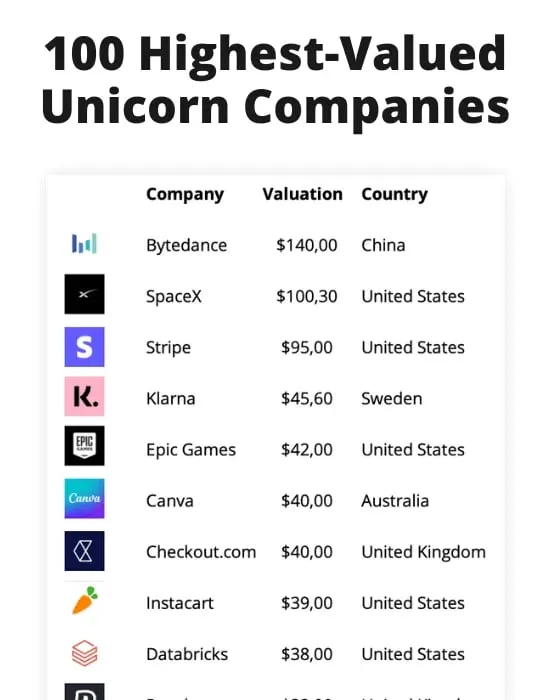
More and more startups worldwide achieved unicorn status in the last few years, taking over the venture capital world. It all started in 2013, when Aileen Lee, a well-known venture capitalist, introduced the “unicorn” name to talk about tech startups with a valuation of $1B or more. From 2013 until now, 1,600+ companies have become unicorns, according to The Crunchbase Unicorn Board.
We previously published a thorough collection of lists with the top unicorns from each industry, country, and city. However, with the rise of unicorns in the venture capital world, it seems that startups are targeting a new level, and decacorns are now the new unicorns.
This is why we want to dive deeper into understanding what decacorns are and what’s so unique about them.
Below, we’ll explore
- What are decacorns
- The complete list of 91 decacorns in the world.
- Differences between unicorns and hectocorns.
- Which company was the first decacorn.
- Some companies with the potential to become decacorns in 2026.
What are Decacorns?
A decacorn company is a private company with more than a $10 billion valuation. Among them, we can find many tech startups from around the world.
Note that I wrote “private.” This also applies to unicorns and hectocorns.
When people and media talk about unicorns, they generally mention all kinds of companies with valuations higher than $1B, including several public ones.
Once a company IPOs, it becomes public and stops being a unicorn, decacorn, or hectocorn.
The Complete List of 91 Decacorn Companies
Unicorns vs. Decacorns
Unicorns are valued at +$1B, while decacorns have a valuation of over $10B.
ElevenLabs, Suno, and Webflow are three examples of unicorns.
Decacorns vs. Hectocorns
We just saw that decacorns have a $10 billion valuation. Hectocorns, instead, are valuated at +$100B.
OpenAI, SpaceX, ByteDance, Anthropic, Ant Group, Reliance Retail, and Databricks are the seven existing hectocorns.
The Rise of Decacorn Startups
As we previously saw here on Failory, the current number of unicorns is continuously rising, and last year 500+ companies in the world achieved unicorn status. But what about decacorns?
Many signs show that being a decacorn is the new unicorn. The term startup unicorn originates from the rarity of mythological creatures, and becoming a unicorn has lately become more common in the market.
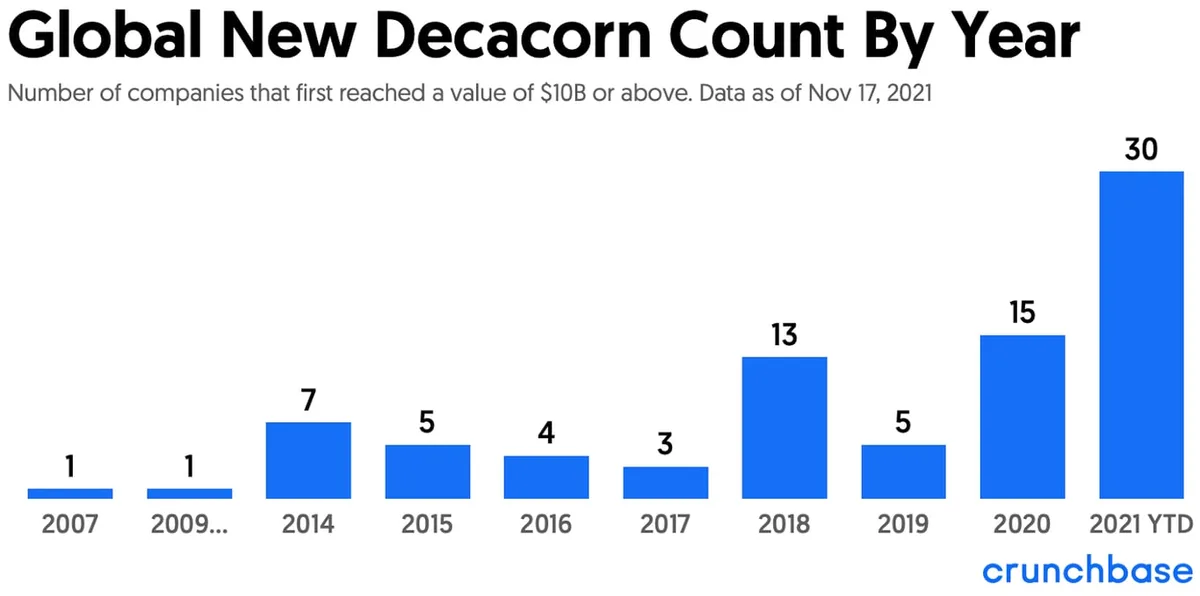
A recent study launched by Crunchbase at the end of 2021 shows us that the number of decacorns is growing exponentially and that the US and Europe startup ecosystems produced the highest numbers of startup decacorns, making them more attractive in the eyes of investors.
Which Was The First Decacorn?
The first decacorn in the world was Facebook (now Meta), which achieved this status in 2017, crossing the $10B valuation after Microsoft's investment round of $240 million.
How Many Decacorns Are There?
We spent the last months collecting a ton of data from different sources about unicorns, which you can find here. From this list, we’ve found that, as of November 2025, there are 91 decacorns out there.
Which Companies Might Be the Next Decacorns?
In their most recent fundraising rounds, many startups were valued just below $10B. This means they should reach the Decacorn startups in the following months or years. Three of these startups are:
- Polymarket: Polymarket operates an information markets platform where users trade on the outcomes of highly-debated global events, and is valued at $9B.
- N26: It’s a German neobank with a wide range of banking solutions for customers in the European Union. In October 2021, N26 closed a $900M Series E funding round at a $9B valuation.
- Vercel: They offer a cloud platform designed to help frontend developers build and deploy faster, more personalized web experiences. Their last valuation was also at $9B.
| Unicorn Startup | Main Industry | Year Founded | Amount Raised | Valuation |
|---|---|---|---|---|
 OpenAI OpenAI | AI | 2015 | $78B | $500B |
 SpaceX SpaceX | Manufacturing | 2002 | $11.8B | $400B |
 ByteDance ByteDance | Media | 2012 | $9.5B | $300B |
 Anthropic Anthropic | AI | 2021 | $33.7B | $183B |
 Ant Group Ant Group | Fintech | 2014 | $28.5B | $150B |
 Reliance Retail Reliance Retail | Retail | 2006 | $8.3B | $101B |
 Databricks Databricks | Analytics | 2013 | $21.8B | $100B |
 Stripe Stripe | Fintech | 2010 | $9.4B | $92B |
 Revolut Revolut | Fintech | 2015 | $1.9B | $75B |
 Shein Shein | Fashion | 2008 | $4.1B | $66B |
 Reliance Jio Reliance Jio | Media | 2010 | $28.4B | $58B |
 xAI xAI | AI | 2023 | $22.7B | $50B |
 Waymo Waymo | AI | 2009 | $11.1B | $45B |
 Canva Canva | AI | 2013 | $2.5B | $42B |
 Ripple Ripple | Crypto | 2012 | $793.8M | $40B |
 Checkout.com Checkout.com | Fintech | 2012 | $1.8B | $40B |
 Figure Figure | AI | 2022 | $1.9B | $39B |
 JUUL JUUL | Retail | 2015 | $16.4B | $38B |
 Safe Superintelligence Safe Superintelligence | AI | 2024 | $3B | $32B |
 Ramp Ramp | Fintech | 2019 | $3B | $32B |
 Anduril Industries Anduril Industries | Mobility | 2017 | $6.2B | $31B |
 Fanatics Fanatics | Gaming | 2002 | $4.9B | $31B |
 Cruise Cruise | AI | 2013 | $16B | $30B |
 Alibaba Bendi Shenghuo Fuwu Gongsi Alibaba Bendi Shenghuo Fuwu Gongsi | Enterprise | 2018 | $4B | $30B |
 Anysphere Anysphere | AI | 2022 | $3.4B | $29.3B |
 Scale AI Scale AI | AI | 2016 | $15.9B | $29B |
 Epic Games Epic Games | Infrastructure | 1991 | $7.9B | $23B |
 Yangtze Memory Technologies Yangtze Memory Technologies | Manufacturing | 2016 | CN¥50.6B | $23B |
 BYJU'S BYJU'S | Education | 2011 | $6.3B | $22B |
 Envision Group Envision Group | Hardware | 2007 | $2B | $21B |
 Perplexity Perplexity | AI | 2022 | $1.5B | $20B |
 FNZ FNZ | Fintech | 2004 | $5.8B | $20B |
 ChangXin Memory Technologies ChangXin Memory Technologies | Hardware | 2016 | CN¥34.3B | $19B |
 Miro Miro | AI | 2011 | $476.3M | $18B |
 JD Digits JD Digits | Retail | 2013 | CN¥34B | $18B |
 Deel Deel | Fintech | 2019 | $1.3B | $17B |
 Xiaohongshu Xiaohongshu | Retail | 2013 | $917.7M | $17B |
 Rippling Rippling | Education | 2016 | $2.4B | $17B |
 Yuanfudao Yuanfudao | AI | 2012 | $4B | $17B |
 Trendyol Group Trendyol Group | Retail | 2009 | $1.9B | $17B |
 Yinwang Smart Technology Yinwang Smart Technology | AI | 2024 | CN¥23B | $16B |
 Kraken Kraken | Crypto | 2011 | $530.6M | $15B |
 PhonePe PhonePe | Fintech | 2015 | $3.2B | $15B |
 Discord Discord | Crypto | 2015 | $995.4M | $15B |
 Applied Intuition Applied Intuition | AI | 2017 | $1.5B | $15B |
 Gopuff Gopuff | Logistics | 2013 | $3.4B | $15B |
 Bitmain Bitmain | Hardware | 2013 | $764.7M | $15B |
 Genki Forest Genki Forest | Food | 2016 | $721.3M | $15B |
 CloudKitchens CloudKitchens | Logistics | 2016 | $1.3B | $15B |
 Mistral AI Mistral AI | AI | 2023 | €2.8B | $14B |
 Helsing Helsing | AI | 2021 | €1.4B | $14B |
 GAC Aion New Energy Automobile GAC Aion New Energy Automobile | Mobility | 2017 | CN¥18.3B | $14B |
 OpenSea OpenSea | Crypto | 2017 | $427.2M | $13.3B |
 Superhuman (formerly Grammarly) Superhuman (formerly Grammarly) | AI | 2009 | $1.4B | $13B |
 Devoted Health Devoted Health | Healthcare | 2017 | $2.3B | $13B |
 Faire Faire | Retail | 2017 | $1.7B | $13B |
 Celonis Celonis | Analytics | 2011 | $2.4B | $13B |
 Brex Brex | Fintech | 2017 | $1.7B | $12.3B |
 Thinking Machines Lab Thinking Machines Lab | AI | 2025 | $2B | $12B |
 Dunamu Dunamu | Crypto | 2012 | ₩968.5B | $12B |
 GoodLeap GoodLeap | Fintech | 2003 | $1.2B | $12B |
 Whatnot Whatnot | Retail | 2019 | $974.7M | $12B |
 Infinite Reality Infinite Reality | Media | 2019 | $3.4B | $12B |
 The Access Group The Access Group | Fintech | 1991 | £1.1B | $12B |
 Airtable Airtable | Infrastructure | 2013 | $1.4B | $12B |
 Northvolt Northvolt | Hardware | 2016 | $13.8B | $12B |
 Biosplice Therapeutics Biosplice Therapeutics | Biotech | 2008 | $778M | $12B |
 Xingsheng Youxuan Xingsheng Youxuan | Retail | 2018 | $5.2B | $12B |
 Oura Oura | Retail | 2013 | $1.5B | $11B |
 Bending Spoons Bending Spoons | Media | 2013 | $4.9B | $11B |
 Quantinuum Quantinuum | Security | 2021 | $925M | $11B |
 Bolt Bolt | Mobility | 2013 | $2.3B | $11B |
 Bilt Rewards Bilt Rewards | Fintech | 2021 | $813.3M | $11B |
 Alchemy Alchemy | Crypto | 2017 | $563.9M | $10.2B |
 Mercor Mercor | AI | 2023 | $483.6M | $10B |
 Cognition Cognition | AI | 2023 | $896M | $10B |
 Neuralink Neuralink | Biotech | 2016 | $1.3B | $10B |
 Colossal Biosciences Colossal Biosciences | Biotech | 2021 | $568.1M | $10B |
 Sierra Sierra | AI | 2023 | $635M | $10B |
 KuCoin KuCoin | Crypto | 2017 | $180M | $10B |
 Crusoe Energy Systems Crusoe Energy Systems | AI | 2018 | $3.9B | $10B |
 Notion Notion | Media | 2016 | $343.2M | $10B |
 Talkdesk Talkdesk | AI | 2011 | $497.5M | $10B |
 Digital Currency Group Digital Currency Group | Crypto | 2011 | $1.3B | $10B |
 Gusto Gusto | Fintech | 2011 | $746.1M | $10B |
 AESC AESC | Mobility | 2007 | $1.4B | $10B |
 Lalamove Lalamove | Media | 2013 | $2.5B | $10B |
 Thrasio Thrasio | Retail | 2018 | $3.4B | $10B |
 Zuoyebang Zuoyebang | Media | 2014 | $2.9B | $10B |
 Chehaoduo Chehaoduo | Mobility | 2015 | $3.8B | $10B |
 Mahindra Electric Automobile Mahindra Electric Automobile | Mobility | 1994 | ₹31.3B | $10B |