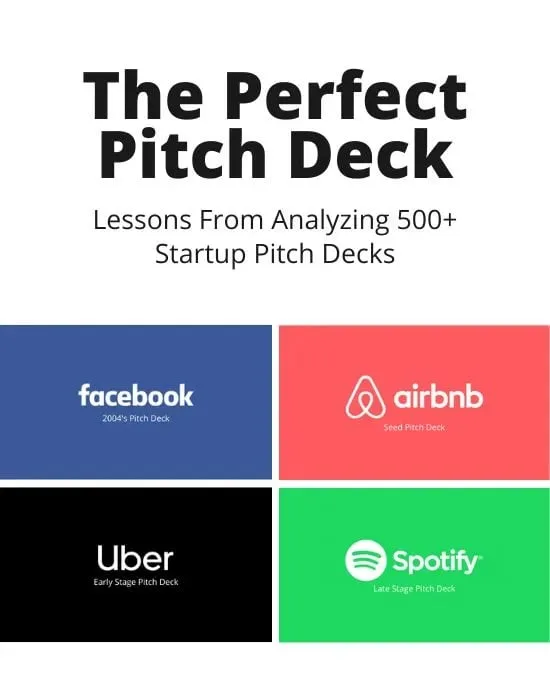
This free eBook goes over the 10 slides every startup pitch deck has to include, based on what we learned from analyzing 500+ pitch decks, including those from Airbnb, Uber and Spotify.
Everything you need to raise funding for your startup, including 3,500+ investors, 7 tools, 18 templates and 3 learning resources.
Buy It For $97 $297 →
Chewse immediately establishes its niche with the tagline, "The only self-service platform built for ordering corporate meals." This approach effectively combines the product category (self-service platform) with the target market (corporate meals) and a strong differentiator ("the only"). The clarity of this statement sets a professional tone and instantly communicates the core value to an investor.
Our Tip: Create a tagline that clearly states what you do, for whom you do it, and what makes you unique.
The deck focuses on the tangible frustrations of corporate meal ordering, highlighting its complexity and inefficiency. By framing the problem around the lack of a user-friendly platform, Chewse makes the pain point relatable to any business that has managed group food orders. This strategy works because it presents a clear, widespread business problem that is expensive in terms of time and hassle, justifying the need for a dedicated solution.
Our Tip: Articulate the problem in terms of its direct impact on your target customer, focusing on the cost, time, or frustration it causes.
Chewse presents its solution as a direct answer to the stated problem: a specialized, self-service platform. The value proposition is anchored in its specific design for corporate needs, which implies features that generic food platforms lack. By emphasizing its unique positioning as the "only" platform of its kind, Chewse creates a strong perception of a defensible niche and first-mover advantage.
Our Tip: Frame your solution not just by its features, but by how it uniquely and directly solves the specific problem you have identified.
The traction slide provides concrete proof of market validation with impressive metrics like $500,000 in annual revenue and 20,000 meals served. These numbers are powerful because they move the conversation from an idea to a functioning business with demonstrated product-market fit. Mentioning that 60% of a $500,000 seed round is already committed adds social proof from other investors, creating urgency and building confidence.
Our Tip: Showcase your most compelling metrics, like revenue, user growth, and capital committed, to prove your business model is viable and gaining momentum.
Chewse’s entire narrative is built around a single, well-defined niche: corporate meal ordering. This focus makes their value proposition incredibly clear and creates the perception of a defensible market position. To apply this, define your target market as narrowly as possible and ensure every part of your deck, from the problem to the solution, reinforces that focus.
The deck effectively uses hard data—$500,000 in revenue, 20,000 meals served, and 60% of a seed round committed—to prove its business model is working. These metrics transform the pitch from a theoretical idea into a tangible business with proven market demand and investor validation. Your takeaway is to quantify your progress wherever possible, as concrete numbers are the most powerful way to build credibility and create urgency.